What are you looking for?
Is aluminum fence cheaper than wood?
For the initial purchase, not always. For the total cost of a long-term fencing project, aluminum can often become the more cost-efficient option once maintenance, replacement, installation, consistency and project downtime are included. A basic wood fence made from locally available timber may have a lower upfront material cost. Aluminum fencing normally requires more manufacturing, extrusion, fabrication and surface finishing before it reaches the project site. However, purchase price alone does not tell a contractor, distributor or developer which fence is actually cheaper.
For bulk projects, the more useful comparison is Total Cost of Ownership (TCO): Purchase price + freight + installation + maintenance + repair + replacement + project risk
This guide explains how aluminum and wood compare from a commercial buyer's perspective and when paying more for aluminum at the beginning may reduce costs later.
The answer depends on what cost you are measuring.
| Cost Factor | Wood Fence | Aluminum Fence |
|---|---|---|
| Initial material cost | Often lower for basic local timber | Often higher |
| Installation | Depends heavily on design and site | Lightweight components may simplify handling |
| Painting / staining | Usually requires periodic attention depending on species and finish | Normally lower routine finish maintenance |
| Moisture / decay risk | Depends on species, treatment and exposure | Not subject to wood rot |
| Insect damage | Can be a consideration in some environments | Not affected by termites |
| Dimensional stability | Can change with moisture conditions | More dimensionally stable |
| Replacement risk | Depends strongly on timber, treatment and maintenance | Often selected for long-term outdoor applications |
| Bulk consistency | Natural variation between timber pieces | Manufactured profiles allow tighter consistency |
| Upfront winner | Often wood | — |
| Long-term cost potential | Depends on maintenance and replacement | Can be lower in low-maintenance projects |
So, are aluminum fences cheaper than wood?
If the buyer is comparing only the first invoice, wood may be cheaper.
If the buyer is comparing a fence system over many years, especially across a large residential, commercial or development project, aluminum can become more economical because fewer maintenance operations and replacement cycles may be required.
The exact result depends on the fence design, timber species, aluminum specification, installation conditions and local labor costs.
Many online fence comparisons start with:
Wood = $X per foot
Aluminum = $Y per foot
For a homeowner comparing one small backyard, that may provide a rough starting point.
For a contractor or bulk buyer, it is often too simplistic.
Two aluminum fences with a similar appearance can have very different manufacturing costs because of differences in:
aluminum alloy;
profile dimensions;
wall thickness;
panel structure;
welding;
surface preparation;
powder coating;
hardware;
packaging.
The same is true for wood.
A treated structural timber fence, cedar fence and low-cost softwood fence should not be treated as one product simply because all three are made from wood.
VTON explains this issue in more detail in why the same fence design can have very different manufacturing costs.
A better commercial comparison begins by making sure the two quotations actually represent products designed for the same:
height, application, expected service environment, privacy level, gate system and quality level.
For bulk projects, use a Total Cost of Ownership calculation.
A practical model is:
Total Fence Cost = Product Cost + Logistics + Installation + Maintenance + Repairs + Replacement
Each part matters differently.
This is the amount buyers usually compare first.
Basic wood fencing can be competitive when suitable timber is locally available and the design is simple.
Aluminum fence manufacturing involves extrusion or profile preparation, cutting, fabrication, welding or assembly, surface preparation, coating and inspection. This often creates a higher starting cost.
However, bulk aluminum pricing can change significantly depending on:
order quantity;
standardisation of panel sizes;
profile dimensions;
wall thickness;
finish;
gate quantity;
packaging method;
container utilisation.
For contractors and distributors, the relevant comparison is therefore not simply “aluminum price versus timber price,” but the landed cost of a complete fence system ready for installation. For current aluminum product configurations, see VTON's aluminum fence range.
This is where the comparison often begins to change.
Wood is a natural material whose performance is affected by moisture and outdoor exposure.
The U.S. Forest Service's guidance on protecting wood fences for yards and gardens discusses the importance of decay-resistant or treated wood, protection from ground contact and suitable finishes for outdoor fencing.
Its broader Wood Handbook also explains how moisture affects wood properties and dimensional movement.
Depending on the wood species, treatment, climate and desired appearance, maintenance may include:
cleaning;
staining;
sealing;
repainting;
replacing damaged boards;
treating weathered areas;
correcting warped or loose components.
One individual maintenance operation may not appear expensive.
Across hundreds or thousands of metres of fencing, however, repeated labor becomes a meaningful operating cost.
Aluminum is generally selected for outdoor construction because of its durability and corrosion resistance. The Aluminum Association identifies durability, corrosion resistance and strength-to-weight ratio among aluminum's important characteristics in building applications.
For a powder-coated aluminum fence, routine maintenance is generally more focused on:
cleaning dirt or salt deposits;
inspecting damaged coating;
checking fasteners and gates;
repairing local surface damage when necessary.
That does not mean an aluminum fence is literally maintenance-free.
Coating quality, installation environment and physical damage still matter.
For example, a low-quality coating can reduce the visual and long-term advantages buyers expect from aluminum. See what makes an aluminum fence look premium for the manufacturing details that affect finished quality.
Replacement cost is one of the most important differences in a long-term project.
Wood fence life varies significantly according to:
timber species;
preservative treatment;
moisture exposure;
ground contact;
climate;
insect exposure;
maintenance.
It is therefore misleading to say that every wood fence lasts a fixed number of years.
A properly specified and maintained wood fence may perform well for a long period, while poorly protected timber in an unfavorable environment may deteriorate much sooner.
Aluminum does not experience wood rot or termite damage, although coating damage, aggressive environments, hardware quality and poor installation can still affect performance.
For developers and facility operators, the question should therefore be:
How likely is the fence system to require major section replacement during the intended ownership period?
Replacing a fence does not involve only buying new material.
The actual cost can include: removal + disposal + new material + delivery + labor + landscaping repair + temporary site disruption.
That is why replacement frequency can have a much larger impact on long-term cost than buyers expect when comparing the original quotation.
Material price and installation cost should be evaluated separately.
Aluminum profiles have a high strength-to-weight ratio and finished panels are relatively easy to handle compared with many heavier metal fence systems.
But installation cost still depends on:
total fence length;
number of posts;
ground conditions;
slope;
gates;
corners;
concrete requirements;
site access;
local labor rates.
A badly planned aluminum fence can still be expensive to install.
Incorrect post spacing, missing accessories or wrong gate dimensions can create rework that eliminates the savings expected from an efficient modular system.
For a more detailed breakdown, see our aluminum fence installation cost guide for contractors.
For large orders, installation efficiency should therefore be considered during the product-design stage, not after the container arrives.
This factor is often missing from residential aluminum-versus-wood comparisons.
For an importer, the relevant number is not factory price.
It is landed cost.
That includes:
product value;
export packaging;
inland transportation;
sea freight;
customs and local charges;
unloading;
transport to the job site;
damaged-product replacement.
A quotation that is slightly cheaper at the factory can become more expensive if panel dimensions produce poor container utilisation or packaging results in scratches and deformation.
This is particularly important for finished aluminum products because protecting the powder-coated surface during overseas transport can reduce site sorting and replacement.
Our guide on how proper fence packaging reduces hidden costs explains why packaging should be considered part of procurement cost rather than a minor shipping detail.
Another hidden cost appears when products do not fit together consistently.
For a small residential fence, an installer may be able to make minor adjustments on site.
Across a large development, repeated variation can increase:
measuring time;
post adjustment;
cutting;
panel sorting;
gate alignment work;
installation labor.
Manufactured aluminum profiles can provide consistent dimensions when material specifications, cutting and fabrication are properly controlled.
However, this advantage depends on manufacturing quality.
Buyers should confirm profile dimensions, wall thickness, drawings, coating and tolerances instead of selecting a supplier based only on product photos.
If you import aluminum fencing directly, review these five checks before importing aluminum fence panels.
Wood can be the more economical choice in several situations.
If the fence only needs to serve for a limited period, paying more for long-term durability may not create an economic benefit.
In regions with an efficient local timber supply chain, wood may have a significant initial price and logistics advantage over imported aluminum fencing.
Wood can often be cut, modified and repaired using widely available tools.
For property owners who perform their own maintenance, the labor cost of staining or replacing individual boards may be less important.
Traditional timber fencing can create full visual privacy using a straightforward board design.
An aluminum privacy fence may require larger profiles, slats or more material, increasing the initial cost.
Some projects specifically require the appearance and texture of natural timber.
In that case, the material decision may be driven more by architecture than by lowest lifetime cost.
Aluminum becomes particularly attractive when the project places a high value on predictable maintenance and consistent appearance.
When hundreds of properties use the same fence design, reducing recurring maintenance across the development can be financially important.
Facilities such as apartment developments, hotels, schools and commercial sites may prefer fencing that does not require regular staining or repainting.
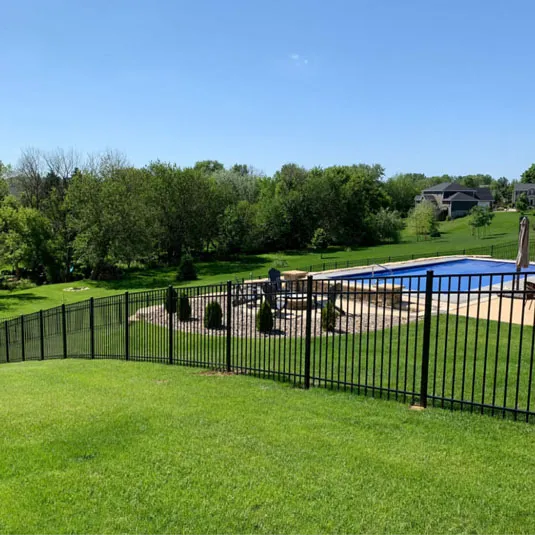
Pool fencing is regularly exposed to outdoor weather and moisture, so corrosion resistance and stable dimensions are useful characteristics.
For pool projects, see VTON's aluminum swimming pool fence.
The higher local labor costs are, the more important maintenance frequency becomes in the TCO calculation.
A material that saves several future maintenance visits can have a very different economic result from one evaluated only by purchase price.
Distributors may also value standardized panels, posts and gates that can be stocked and reordered consistently.
In this case, product consistency and repeatability become part of the economic comparison.
Rather than publishing one fixed “25-year cost” number, buyers should model their own project.
A useful comparison looks like this:
| Cost Item | Year 0 | During Ownership | Replacement Stage |
|---|---|---|---|
| Wood | Material + installation | Cleaning, finishing, repairs as required | Possible section or full replacement depending on condition |
| Aluminum | Material + installation | Cleaning, inspection, hardware/coating repair as required | Depends on product quality, environment and damage |
The longer the ownership period, the more important the second and third columns become.
For a five-year project, the lower initial material price may dominate the decision.
For a long-term development, repeated maintenance and replacement become much more important.
This is why there is no responsible universal answer such as:“Aluminum always becomes cheaper after eight years.”
The break-even point can be very different between two projects.
Instead of asking suppliers only:“What is your price per metre?”ask for enough information to compare the complete system.
Confirm:
aluminum alloy;
profile dimensions;
wall thickness;
panel dimensions;
post specifications;
surface treatment;
coating specification;
gate hardware;
fasteners;
packaging;
container loading quantity;
production tolerance;
lead time.
Confirm:
wood species;
grade;
moisture condition;
preservative treatment;
board dimensions;
posts and rails;
finish;
expected maintenance;
local installation method.
Only after these specifications are aligned does a price comparison become useful.
There is another common mistake.
A buyer decides aluminum must match the cheapest timber quotation and then reduces material specifications until the price is similar.
That can defeat the purpose of choosing aluminum.
Reducing:
profile wall thickness;
post size;
coating preparation;
hardware quality;
protective packaging
may lower the purchase price, but it can increase deformation, coating defects, installation problems or complaints later.
For commercial sourcing, the goal should not be:
“How can we make aluminum as cheap as possible?”
It should be:
“What aluminum specification gives the required performance at the lowest sustainable total cost?”
That is a much more useful procurement question.
Appearance is subjective.
Wood provides a natural texture that many residential projects specifically want.
Aluminum provides a cleaner, more uniform architectural appearance and can maintain consistent panel dimensions and color when manufacturing and coating are properly controlled.
Premium appearance depends on more than material.
For aluminum fencing, visible weld quality, surface preparation, coating consistency, straight rails and careful packaging can all affect how the finished project looks.
Two black aluminum fences may therefore have very different visual quality even if the photographs in the quotations appear similar.
Aluminum is not automatically the right choice for every project.
Its main disadvantages can include:
Higher initial cost.
A well-specified aluminum system may cost more to purchase than a basic timber fence.
Different privacy characteristics.
Traditional picket aluminum fencing is relatively open. Privacy designs require slats, screens or more material.
Dependence on manufacturing accuracy.
Custom aluminum products should be manufactured from correct drawings. Errors in panel dimensions or gate openings are less convenient to correct on site than cutting a timber board.
Surface damage can be visible.
Powder-coated components need suitable packaging and handling to avoid scratches during transport and installation.
International procurement requires planning.
Imported fencing introduces production lead time, freight and inventory considerations that a locally purchased timber fence may not have.
These disadvantages should be included in the cost comparison rather than hidden behind a simple claim that aluminum is “better.”
They can be, particularly when the buyer's business depends on predictable quality and repeat orders.
For contractors, fewer product variations and lower long-term maintenance can support smoother installations and fewer callbacks.
For distributors, standardized aluminum systems can provide:
repeatable specifications;
multiple design options;
consistent finishes;
coordinated gates and posts;
private-label opportunities;
bulk procurement.
However, these benefits depend heavily on the manufacturer.
The lowest factory quotation is not necessarily the lowest landed or installed cost.
Buyers should evaluate material specifications, production control, packaging and technical support together.
For upfront cost, wood often has the advantage. For long-term total cost, aluminum can have the advantage.
The decision should not be based on one universal price-per-foot figure.
For bulk buyers, contractors and developers, compare: initial material cost + freight + installation + maintenance + repair + replacement + project risk.
Wood remains a practical choice when local material cost is low, natural appearance is important or the project has a short ownership horizon.
Aluminum becomes particularly attractive when buyers value low maintenance, consistent dimensions, corrosion resistance, repeatable manufacturing and long-term project performance.
If you are evaluating aluminum for a residential, pool or commercial project, explore VTON's aluminum fence systems and compare the required panel dimensions, posts, gates and finish against the complete lifetime cost of the alternative—not only the initial purchase price.
Wood is often cheaper at the initial purchase stage, especially when basic timber is locally available. Aluminum may become more cost-effective over a longer ownership period because it generally requires less routine finish maintenance and is not affected by wood rot or termite damage.
They can be, but there is no universal break-even period. The result depends on initial price, local maintenance labor, wood species, climate, aluminum quality, installation and how long the fence is expected to remain in service.
Wood commonly requires more attention to moisture protection, finishes and damaged components. Properly finished aluminum fencing generally requires cleaning, inspection and occasional repair of damaged coating or hardware rather than routine staining.
The service life of both materials depends on specification, environment and maintenance. Aluminum is resistant to decay and termites, while wood performance depends heavily on species, treatment, moisture exposure and maintenance. Avoid relying on one fixed lifespan number for every fence.
Bulk production can improve the economics of aluminum fencing through standardized panel sizes, volume purchasing and efficient container loading. Whether it is cheaper overall still depends on freight, installation and the alternative wood specification.
Aluminum is commonly used for pool barriers because of its corrosion resistance, low weight and ability to be manufactured into consistent panel and gate systems. The finished installation must still meet the pool barrier requirements applicable to the project location.
Powder coating is only one part of the manufacturing cost. Aluminum alloy, profile size, wall thickness, fabrication, welding, surface preparation, hardware and packaging can all affect the quotation.
Price per metre is useful only when the compared systems have equivalent heights, specifications, posts, gates, finishes and accessories. For commercial purchasing, comparing the complete landed system is more accurate.